
"The only way to win is to learn faster than anyone else." — Eric Ries, The Lean Startup
Back in 1999, I had an awesome idea for a new startup. I was so excited I could barely contain myself. It was the height of the dot-com boom in Silicon Valley, and all my friends were getting filthy rich.
I spent late nights producing a pitch deck for my startup. Surely, this set of slides would convince investors that my idea was brilliant and worthy. After many long hours, my pitch deck was finally perfect, and I asked for a meeting with a friend who had recently joined a venture capital firm. I walked into his conference room early on a chilly November morning, feeling confident and prepared.
By the end of the meeting, we were high-fiving about how awesome my idea was. His firm led a $5 million initial round of financing, and I was off to the races.
With funding secured, I quickly recruited an all-star team of twenty software engineers to build my awesome idea. We labored for two years, fully convinced that our idea would be a big hit with customers. All the ingredients were in place—we had a great startup idea, we were obviously a brilliant team, and we were backed by incredibly smart venture capital investors—what could go wrong?
Well, after spending two years and $5 million building a product we thought was fantastic, we released it, only to find out that no customer wanted it. Customers didn't care about all the work we put into building the product because it didn't solve problems they cared about. My awesome idea was a complete failure.
This has been a recurring issue since the dawn of entrepreneurship: how does one reliably create new products that succeed?
We've all seen examples of companies large and small that put enormous effort into developing a new product they are sure will be a success, only to find out that customers don't want it.
The research firm CB Insights conducts an annual post-mortem survey of failed startups, and year after year, they find that "no market need" remains a leading cause of startup death. How the hell do you build and fund an entire company without first determining whether there's a market need? It seems ridiculous, yet it happens over and over again. I've done it myself.
The worst new product failure in history
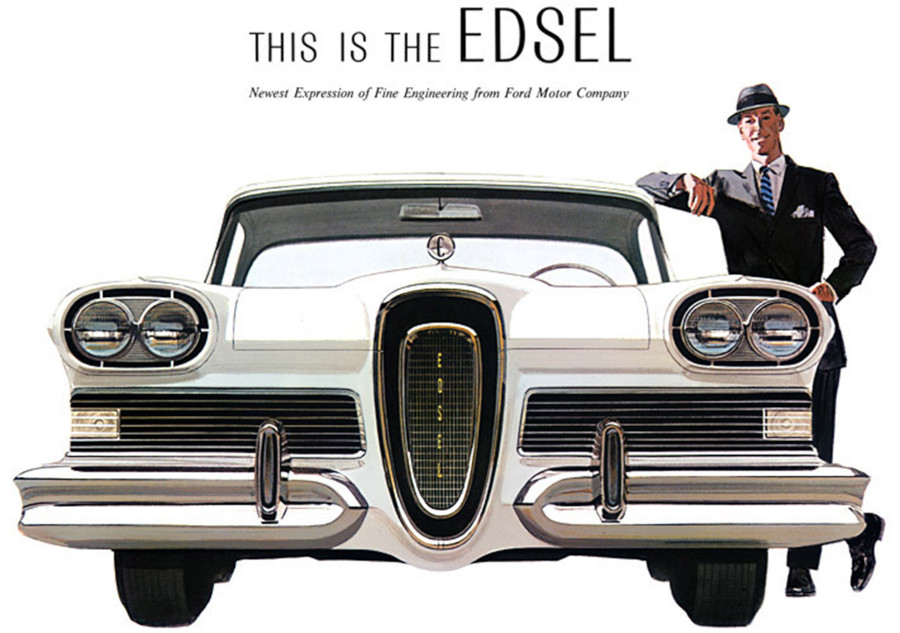
While my own experience was painful, others have had it much worse. The greatest new product failure in American history was probably the Ford Edsel. It's still legendary for how spectacularly it failed, and the name has become synonymous with disastrous product development.
The Ford Motor Company had an initial public offering (IPO) in 1956. Led by Goldman Sachs, the offering raised $650 million (more than $7 billion in 2023 dollars). It was the most successful IPO in American history at the time, and Ford decided to spend a chunk of that shiny new cash developing the most sophisticated automobile line on Earth. They hired the world's top automotive engineers, who then spent three years and $250 million developing the new car they called the Edsel, named for Henry Ford's son. The engineers had developed exciting new features like push-button transmission shifting, self-adjusting brakes, triple-thermostat cooling, and a state-of-the-art 410-cubic-inch engine.
Ford executives were so sure of success that they launched the Edsel with not just one but eighteen new models spread across four lines and a $12 million advertising campaign developed by the famous Madison Avenue ad agency Foote, Cone & Belding. The Edsel's tagline, glamorizing it as "the newest expression in fine engineering from the Ford Motor Company," drove home the idea that it was indeed the most advanced automobile ever produced.
But despite the huge engineering and advertising investment, the Edsel failed to sell. Out of the projected sales of one million units, only sixty thousand were sold the first year, followed by fifty-six thousand the second year, and then Ford shut down the entire production in the third year. The Edsel line lost $350 million (over $3 billion in today's dollars) and went down in history as the most spectacular new product failure ever.
Successful product innovation occurs at the intersection of what is technically feasible, has positive economics, and aligns with what customers want. The Edsel had one of those: the engineering was feasible. But it didn't align with what customers wanted, and the manufacturing economics were upside down.
Entire books have been written about the Edsel's failure, and as a case study, it has been taught in MBA classrooms for many years. Yet we continue to see companies spend a lot of money developing products they are sure will be a success, only to find out customers don't want them.
Product-Market Fit
A few years ago, in an attempt to put a framework around developing products that actually succeed, Silicon Valley venture capitalist Andy Rachleff developed the concept of Product-Market Fit, suggesting that the entire goal of a startup is to achieve a fit between what your product does and what the market wants. I didn't achieve Product-Market Fit with my startup in 1999, and Ford didn't achieve it with the Edsel in 1958 (nor did several thousand companies since then). The notion of Product-Market Fit is a critical one that every startup founder needs to understand.
Marc Andreessen expanded on the Product-Market Fit concept in an article he wrote for the Stanford School of Engineering:
"Product/market fit means being in a good market with a product that can satisfy that market."
"You can always feel when Product-Market Fit isn't happening. The customers aren't quite getting value out of the product, word of mouth isn't spreading, usage isn't growing that fast, press reviews are kind of 'blah,' the sales cycle takes too long, and lots of deals never close."
"And you can always feel when Product-Market Fit is happening. The customers are buying the product just as fast as you can make it—or usage is growing just as fast as you can add more servers. You're hiring sales and customer support staff as fast as you can. Reporters are calling because they've heard about your hot new thing and they want to talk to you about it. You could eat free for a year at Buck's."
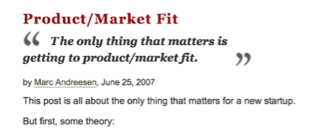
Marc Andreessen succinctly summarizes the whole concept by stating that, with startups, "the only thing that matters is getting to Product-Market Fit."
If this is indeed "the only thing that matters" for startups, then there is only one question: how do we achieve Product-Market Fit most effectively? There are three concepts I wish I had understood when I founded that software business back in 1999: Customer Development, Lean Startup/MVP, and Design Thinking.
Customer Development
Steve Blank coined the term Customer Development. Steve is a crusty startup veteran often called the godfather of Silicon Valley startup methodology. He and I had lunch together at a Thai restaurant a few years ago, and he told me a story about an experience he once had when he was a startup CEO.
"We had a new product under development," Steve said. "It wasn't quite ready, but my top salesperson and I decided to go out and meet with some customers so we could tell them about our exciting new product that would be available next quarter."
They built a slide deck about the product and all its amazing features, then hit the road to meet customers. "After the first customer meeting, we realized the product was all wrong, so while my sales guy drove us to the next customer meeting, I sat in the passenger seat and edited the slide deck based on the feedback we had received." The day continued, repeating the same process. After each meeting, they would update the slide deck about the product based on the input they received. Steve finished his story to me with "By the end of the day, the product in our slide deck was perfect, but unfortunately, it wasn't the product our engineering team had been building."
From that experience (and others), he realized that we were all doing it backward. We needed to be doing what he called Customer Development before we did product development.
Steve founded eight companies in his career. Four had successful IPOs, while four failed so spectacularly that they left (in his words) "giant craters in the ground." He then semi-retired and wrote a book called The Four Steps to the Epiphany: Successful Strategies for Products that Win.
In his book, Steve writes about how startups tend to conduct product development, then after the product is developed, they go out and try to find customers (I did that and ended up losing a lot of money). A process with a much higher likelihood of success, Steve writes, would be first to spend a whole lot of time talking to customers and then build a product based on what you've learned from their real-life experiences.
He breaks Customer Development down into four steps:
Customer discovery first captures the founders' vision and turns it into a series of business-model hypotheses. Then it develops a plan to test customer reactions to those hypotheses and turn them into facts.
Customer validation tests whether the resulting business model is repeatable and scalable. If not, founders should return to customer discovery.
Customer creation is the start of execution. It builds end-user demand and drives it into the sales channel to scale the business.
Company building transitions the organization from a startup to a company focused on executing a validated model.
For the purposes of the Launch Path, we will focus on the first two steps, as they are the most applicable to early-stage startup ventures.
In a nutshell, early-stage Customer Development is about validating your assumptions by talking to actual customers and making sure your product development roadmap is informed by real-world data. Like everything else in our Launch Path methodology, it's an ongoing process—you don't just do one set of Customer Development interviews and declare that you're done. Instead, you want to have the mindset of always making sure that what you're building has been tested and validated by interactions with real customers.
As startup founders, we have a set of untested hypotheses about who the customer is, what features they want, what channels to use, etc. But you don't want to build a product based on untested hypotheses; you want to build a product based on actual validated facts. That's the heart of the Customer Development concept.
Lean Startup/MVP
The term "Lean Startup" was popularized by Eric Ries in his 2009 book of the same name, based on the previous work of Steve Blank. It's a methodology for developing businesses and products by shortening development cycles via experimentation and validated learning.
Contrary to popular belief, the "lean" in the title doesn't mean cheap. You could use the Lean Startup methodology with a $100 million budget. The name "Lean Startup" comes from the auto industry and the fact that Toyota revolutionized that sector with their Lean Manufacturing methodology, which advocated shorter production cycles and a more iterative approach to building products.
Ries preaches that startups can successfully use the principles of Lean Manufacturing combined with the scientific method. Your assumptions are just hypotheses, so find ways to test them empirically!
Central to the lean startup methodology is the concept of a Minimum Viable Product (MVP). The idea is simple: a startup should test their product idea by first building a bare-bones prototype with a minimum set of features, then put it into the market to learn from. Based on those early learnings from your MVP, you can develop a product roadmap informed by real users.
The key thing many people miss is that the purpose of building an MVP is learning, not showing (more on this in the next section).
Think of how Facebook launched with just a bare minimum set of features, but today it has a zillion features, all informed by watching the interactions of real users. That is the lean startup concept in action.
Design Thinking
David Kelley, who designed many of the early Apple products, went on to found the design consultancy IDEO (and then the d.school at Stanford) and popularized a product-engineering framework known as Design Thinking. Its five steps are to:
- Empathize (develop a deep understanding of the user).
- Define (develop a point of view around a problem).
- Ideate (brainstorm about how you can solve that problem).
- Prototype (build an early set of MVPs).
- Test (get input on your prototype from actual customers).
By iterating through the Design Thinking process, you will end up with an innovative product that aligns with the needs of your customers. Over the years, several related frameworks have been developed, including User-Centered Design, Value-Centered Design, Product Thinking, and others. They all have proponents and adherents, but to me, they are all variations of the same theme: don't just build a product you think is awesome; use a process that helps you build a product customers think is awesome.
But it's just common sense, really.
All of these terms, "Product-Market Fit," "MVP," "Lean Startup," and "Design Thinking," get tossed around as if they were magic elixirs. Honestly, it's really just the common-sense way that successful businesses have always been built.
Let's say we wanted to open a neighborhood bakery. Our goal is to bake bread that our neighborhood actually wants to eat (Product-Market Fit). We might begin by asking our neighbors about their taste in bread so we can understand what they care about (Customer Development). Based on this, we'll brainstorm some recipes (Design Thinking). Then we'll make some small batches for them to taste and give us feedback on (prototyping).
Now we'll do a neighborhood pop-up one weekend (an MVP). Then maybe we should set up a booth at some farmers' markets to learn a little more about the economics of selling bread (another MVP!).
If we take these steps before we lease an expensive building and build out an expensive bakery kitchen, we will have a much greater chance of success (Launch Path, baby!).
The fancy management consulting companies will be happy to sell you some magic elixir advice filled with buzzwords if you'd like.
But fundamentally, it's just the common-sense way that successful businesses have always been built.
Chapter Summary
Successful startups are built upon a series of small experiments. As entrepreneurs, we go into the startup process with many assumptions about what we think customers will buy. But building a new product or service entirely based on what you think the world needs has a very low likelihood of success (I've tried it and lost a lot of money).
So always be thinking about small experiments you can do to validate your assumptions with real customers.
Ultimately, what matters is achieving Product-Market Fit, a fit between what your product does and what the market wants. Therefore, your focus should be on whatever will help you get there efficiently and effectively.
- Spend a lot of time talking to prospective customers up-front (do Customer Development before you do product development).
- Embrace the fact that most of your assumptions will be wrong, and success depends on testing your assumptions before the market tells you just how wrong you are.
- Always be thinking, "What's the smallest experiment I could do right now that would provide the greatest possible learning?"
- Embrace the concept of your Minimum Viable Product (MVP) as a great way to learn from the marketplace. Don't think of an MVP as a one-time deal; instead, using multiple MVPs is part of the process by which you are getting validated knowledge of the market as you continue to iterate and improve your journey toward Product-Market Fit and beyond.
Remember that everything in this chapter is best thought of as an ongoing process. I once had a student ask me, "So when can I stop iterating on my product?" and the answer, of course, is never!
Successful companies are continually iterating on product offerings based on input from real customers. Product-Market Fit is an ever-shifting target as customers change, markets change, and competitive landscapes change.
Journey sang, "Don't stop believin'," and I'll add to that, "Also, don't stop iterating."
That's how great ventures (and great rock 'n' roll) are built.