
"If you're competitor-focused, you have to wait until there is a competitor doing something. Being customer-focused allows you to be more pioneering." — Jeff Bezos
I had dinner with my friend Richard Draeger one evening before a jazz show in Menlo Park. His Draeger's Markets—big, beautiful food emporiums brimming with all things delicious—operate several locations around the Bay Area. The business dates back to Richard's grandfather, who quickly obtained the very first liquor license in San Francisco County when US prohibition laws were repealed in 1933. That's my kind of entrepreneur.
Richard and I were enjoying our Chinese meal when I asked how business was going for him. For many years, Draeger's Markets were the upscale grocery stores in the area, but then Whole Foods moved in, Trader Joe's started to proliferate, and now even the big supermarket chains have embraced the sort of artisan, premium, fresh foods that Draeger's is known for. Yet somehow, even in the face of all that new competition, Draeger's Markets continue to grow and thrive.
Richard is clearly doing something right, so I asked him what brilliant strategy he was using to battle all the new competition. "I don't know," Richard shrugged as he reached for another serving of yummy Szechuan string beans. "I just focus on making my business better."
I think Richard's response is excellent advice for startup founders everywhere. Rather than obsess about competitors, just focus on making your business better.
Some founders become too obsessed with competition; the fact is that startups rarely fail because of competition. Startups fail because their product doesn't meet market needs; they fail because of bad financial management; they fail because the unit economics are upside down. In short, ninety percent of them fail because the team doesn't properly execute. The data is clear on this. Someone else with the same idea ain't what kills startups.
But how you are positioned within your competitive landscape does matter. If you want to be a successful entrepreneur, you'll need to hold two truths in your mind at the same time:
- Obsessing about competition is a waste of time—that's not what matters.
- It's still important to research and understand the landscape of competitors and alternatives you are operating within.
One former student has been working on his startup for two years. He's in "stealth mode" because he doesn't want anyone to steal his idea. Every time I check in on him, he tells me all about what the competitors are doing. He's spent two years obsessing about competitors instead of talking to actual prospective customers and building a company. At this point, I'd estimate that he has an approximately 100% chance of failure. As Jeff Bezos (founder of Amazon) has said, "If you're competitor-focused, you have to wait until there is a competitor doing something. Being customer-focused allows you to be more pioneering."
Don't pretend you have no competition.
One of the worst statements an entrepreneur can make in an investor pitch is, "Best of all, we have no competition!" There is competition for everything. If you claim you have no competition, then that either means there is zero demand for what your startup does or you don't know how to use Google search. Either way, you look like a fool.
In fact, competition is usually good. If other companies are successfully selling something like what you're selling, that means there is established demand for what you offer. Now you just have to be better or different in some way. That's much easier than needing to create demand for a product where there isn't any.
No competitors is a red light, not a green one.
During the dot-com boom, there was a notion known as "the first-mover advantage." It suggested that if you were the first to launch an e-commerce website dedicated to selling toasters, for example, you would end up owning the toaster market. The notion turned out to be almost completely false—there are very few examples of companies that now own a category because they were first.
In fact, for the most part, history indicates that it's the other way around. Webvan was the first online grocery delivery company, and they failed miserably, blowing through $800 million in capital and paving the way for "second movers" to develop many subsequent successful online grocery delivery services.
Palm, General Magic, and BlackBerry were early smartphone pioneers who failed, paving the way for Apple and Android to make it a billion-dollar business. There are many other examples. As Willie Nelson said, "The early bird may get the worm, but the second mouse gets the cheese."
So, don't obsess too much about competition, and especially don't think that it's an advantage to find a startup idea where there is no competition. A hole in the market usually doesn't represent a green light—it's usually a giant red flag.
But do conduct solid research.
Create a spreadsheet that lists all your competitors and their salient information: how big they are, their focus within the space, etc. You may also know of some companies in the space that failed. You'll want to have a list of those too, especially if their failures can provide important insights. The Wayback Machine at archive.org comes in handy here.
Remember that ultimately we want to have a list of competitors and alternatives. With many startups, you are competing less with direct competitors than with alternative ways of solving the problem your startup addresses. In the Juicero case study (Week 2), they failed because there were plenty of other ways to juice fruits and vegetables without the hassle of a subscription.
Clayton Christensen, the late, great Harvard Business School professor, wrote that when consumers buy your product, they are actually "hiring it to do a job," so when a consumer looks at a landscape of products, it's because they have a job to be done. As we saw with Juicero, when a consumer is looking to "hire" the right product to make juice, there are many options—some direct Juicero competitors and some not.
In this week's sidebar, you'll find lots of tools for competitive research. So, do your homework, then make a comprehensive list of your competitors and alternatives. Keep the list in a spreadsheet you can regularly update and share with your team.
Do not create a "feature checklist."
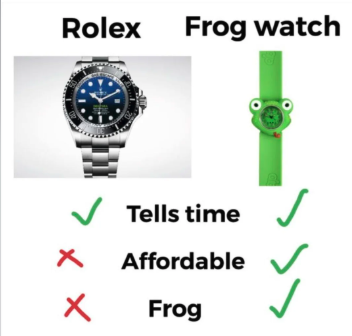
I often see newbie entrepreneurs create a "feature checklist" slide and think that's their competitive landscape. The slide always shows their features compared to their competitors' features (and of course, it always shows that the new startup has more). It's an entirely useless slide because it assumes that the product with the most features will win (which is seldom true). A feature checklist tells us nothing about the landscape of competitors and alternatives. And it assumes the wrong thing, so why the hell would you do this?
Engineers develop features, but customers buy benefits. Don't put a boring feature checklist slide in your pitch deck. It may appeal to engineers, but it's meaningless to customers and investors. Instead, figure out a way to draw a visualization of the landscape of your competitors and alternatives and how you fit in. Remember, competition is good, so don't be afraid to add a lot of competitors. In the retail world, for example, there's room for Target, Nordstrom, and Costco, but they occupy very different spots within the landscape.
Think about whether you can create a nice, two-dimensional representation of the landscape showing how you and the other players fit in. One axis could represent price, and the other one could represent a focus on durability. Or one axis could be consumer-focus versus enterprise-focus, and the other could be, say, bandwidth consumption.
There are many ways to create a visualization of a landscape of competitors and alternatives, so choose a method that you think represents your landscape well. If your startup is a marketplace (see further discussion of this in Chapter 4), then you'll probably want to create two landscapes, one for each side of your marketplace.
But don't pretend you have no competition, and don't think that a feature checklist means anything because it doesn't. Nobody wants to buy your frog watch.
Come up with a visualization that shows you understand the landscape and are intentional about your positioning.
Every venture operates within a landscape of competitors and alternatives, and every great startup CEO knows that positioning matters. Do your research on all the competitors and alternatives—that's important—but then stop worrying about that and obsess about execution, not competitors.
Calculating Market Size
As you survey the landscape, you'll need an idea of your startup's market opportunity size. Don't obsess about this too much; startups seldom fail because the market wasn't big enough. Conversely, don't think that a huge market size guarantees success. Many startups have failed despite a pitch deck touting the "$500 billion available market!"
In measuring and expressing market size, three terms are typically used:
TAM (Total Addressable Market): This is the total market demand for your product or service. It's usually a ridiculously large number that sounds very impressive but is relatively meaningless because your applesauce startup will never get one hundred percent of the worldwide applesauce market.
SAM (Serviceable Addressable Market): This is the amount of the TAM you could potentially reach, given your geography and business model. Maybe our applesauce startup is targeting just the direct-to-consumer applesauce market in the United States. That's our SAM.
SOM (Serviceable Obtainable Market): Unless you're a monopoly, you'll never get one hundred percent of the SAM. Given the benefits your applesauce offers customers, what percentage of the total available customers could potentially become yours, and how much would they buy?
When it comes to finding market size data for your startup, Dr. Google is your friend. A few minutes of searching usually turns up some data from reputable sources. Industry associations typically have market size data available, as do research firms such as Gartner and CB Insights. Find some data, and then cite your sources.
Your startup will operate within a landscape where customers spend a certain amount of money, in the aggregate, to solve the problem your startup solves. Be realistic about this fact. Don't claim that you have no competition, and don't suggest that you can get one hundred percent of the market. Instead, do some research on the size of the market you could potentially reach, think about how your startup will be positioned within that landscape, and do a realistic assessment of how much of the market your startup might reach.